Fitness Routines That Improve Strength and Flexibility
Emily Ward October 2, 2025
In 2025, fitness enthusiasts are moving beyond the old divide between strength training and stretching. The hottest routines are ones that fuse both goals—delivering strength gains and improved mobility in the same session. Below, we explore emerging trends, the science behind them, and actionable routines you can adopt now.
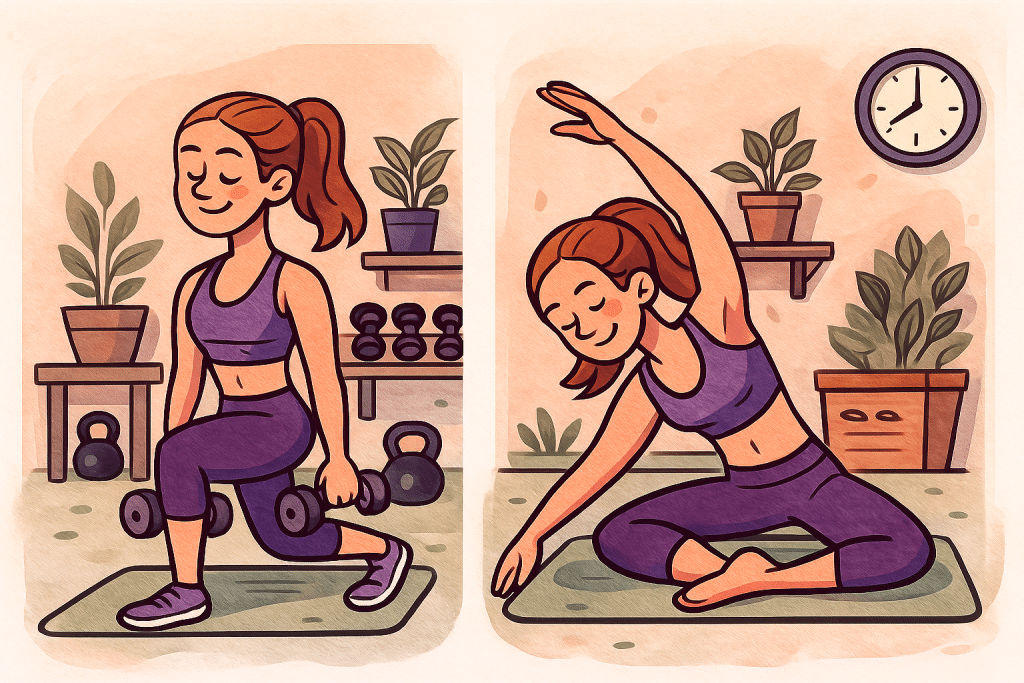
Why combining strength and flexibility matters
Traditionally, strength training and flexibility (or stretching) were treated as separate domains. But recent evidence shows that combining them intelligently can yield better outcomes than working them in isolation.
- A 2024 study comparing resistance training through a large range of motion to static stretching found that resistance training yielded greater strength gains while achieving similar flexibility improvements (when matched for time and stretch intensity).
- Another review notes that many forms of strength training, when properly programmed, do not reduce range of motion—and in some cases improve it.
- The influence of resistance training on joint flexibility appears especially strong when high-intensity protocols are used.
So, instead of seeing stretching as a side task, the emerging philosophy is: train strength in full mobility.
That shift underpins many rising routines in 2025.
Top Trends in Strength + Flexibility Training (2025)
Here are some of the notable directions gaining traction this year:
1. Mobility‑strength training (Movement + Strength fusion)
Rather than isolating “mobility work” and “lifting,” these routines integrate them:
- Think loaded deep squats, overhead presses with soft tissue activation, or deadlifts through maximal hip flexion.
- Mobility-first strength circuits, where each set is preceded by a joint-specific mobility drill.
Mobility training itself has become a buzzword—dynamic stretching, yoga-inspired flows, and joint drills are no longer just warmups, but core components.
2. Primal movement, animal flow, and “movement culture”
Movement culture has seen a resurgence. Disciplines like Animal Flow and Ido Portal’s movement method are being re-adopted not just for flexibility, but for strength, control, coordination, and resilience.
- Animal Flow (ground-based, four-limbed locomotion, transitions, crawls) is now being promoted as more than just a cool bodyweight trend—it emphasizes core stability, joint mobility, and strength through movement.
- The Ido Portal method emphasizes mastering bodyweight control, inversions, and fluid transitions, with flexibility and strength built hand‑in‑hand.
These practices are attractive because they require minimal equipment and emphasize physical literacy.
3. Time‑efficient, high‑intensity protocols with full ROM
In a world where “lack of time” is consistently cited as a barrier, protocols that deliver both strength and flexibility gains in less time are rising.
- A narrative review points out that using supersets, drop sets, or rest-pause techniques can roughly halve the time required for resistance training, while maintaining volume.
- Similarly, research shows that strength training through full ranges of motion can substitute or complement traditional static stretching.
So, the new paradigm: Don’t “exercise then stretch.” Design routines where strength work is already stretching you.
4. AI, wearables, and feedback‑driven training
The technology wave is touching strength + flexibility as well:
- According to ACSM’s 2025 trends, wearable technology, mobile apps, and data‑driven training are top influences in fitness programming.
- New research introduces smart sportswear embedded with sensors (e.g. strain sensors) to monitor form, symmetry, and biomechanical errors in real time.
- Datasets like FLEX, designed for fitness action quality assessment, aim to help algorithms give corrective feedback on both strength and mobility movements.
Imagine your shirt or leggings subtly vibrating to warn you: “Your hip is dropping too much—tight glute engagement needed.” That feedback loop has the potential to accelerate safe gains in strength and flexibility.
5. Hybrid recovery & soft-tissue integration
Recovery modalities are being woven into active training sessions:
- Alternating strength sets with mobility flow, foam-rolling protocols between lifts, and combining isometric holds with soft tissue techniques.
- This approach is about resilience: using movement breaks and stretching as “active recovery” even within a session.
These “hybrid rest” strategies are gaining traction in boutique gyms and advanced trainer toolkits.
Sample Hybrid Strength & Flexibility Routine
Below is a weekly plan combining strength and flexibility into unified sessions. It’s designed for intermediate level (you can adjust volume or rest times up/down).
Key principles:
- Always start with a movement prep warmup (joint circles, activation).
- Perform strength work through full (or near-full) range of motion.
- Insert mobility or flow “mini‑sets” between strength sets.
- Use feedback (mirror, wearable, coach) to monitor form.
Weekly outline (4 sessions):
| Day | Focus | Sample structure |
|---|---|---|
| Day A – Lower body + hips | Squats and hip mobility | Deep goblet squats 4×8 + between sets, 30 sec hip CARs (controlled articular rotations) + glute bridges + deep lunge flow |
| Day B – Upper push + thoracic mobility | Pressing strength + upper back flow | Dumbbell overhead press 4×8 + between sets, 10 reps of thoracic openers & band pull-aparts |
| Day C – Rest / Active recovery | Movement flow | Animal Flow session (~20 min), foam rolling, deep stretching |
| Day D – Lower + posterior chain | Deadlift and posterior mobility | Romanian deadlifts 4×8 + between sets, 30 sec hamstring flossing + Cossack squats |
| Day E – Upper pull + scapular flow | Pull strength + shoulder mobility | Pull-ups or rows 4×8 + between sets scapular dislocates & wall slides |
| Days F & G – Rest / optional light movement | Gentle yoga, walking, or core flow | Soft mobility flow, light yoga, breathing work |
You can cycle the mini‑mobility flows (hip CARs, thoracic rotations, scapular drills) based on the muscles you’re stressing that day.
Example of integrated set (Day A):
- Warmup: leg swings, glute activation, bodyweight squats
- Set 1: Goblet squat (8 reps)
- Mini-flow: hip internal/external rotations (10 per side)
- Set 2: Repeat goblet squat
- Mini-flow: 30 sec deep lunge + backbend
- Continue for all sets
This blends strength stimulus and mobility stimulus in one session.
Key Tips to Succeed in a Strength & Flexibility Routine
- Progressive overload still matters: Even if the movement is fluid, your strength stimulus should increase over time (weight, reps, complexity).
- Focus on quality over quantity: Full control through range is more important than how many reps you do quickly.
- Use smart variation: Rotate movement patterns so you don’t overstress the same joints.
- Incorporate rest flows: Between intense sets, use small mobility bursts to prevent stiffness.
- Get feedback: A mirror, coach, or sensor-equipped wearables can catch subtle alignment errors you might ignore.
- Be patient with new modalities: Movement-based flows like Animal Flow can feel awkward at first—allow 2–4 weeks just to build comfort.
Why this is hot in 2025
- Efficiency demand: With modern life squeezing time, people want “two benefits in one workout.” Integrating flexibility into strength saves time.
- Movement culture revival: The return of primal and movement-first methods (Animal Flow, Ido Portal) reflects a shift toward holistic physical literacy.
- Tech support: Wearables, AI feedback, and motion analysis make it easier to train safely and effectively.
- Evolving fitness trends: Strength training, functional fitness, and data-driven exercise are all top trends per ACSM’s 2025 forecast.
- Evidence backing integration: As the research cited above shows, you no longer need to pit strength vs flexibility—they can co‑exist, and often synergize.
Closing thoughts
The frontier for strength and flexibility training in 2025 is integration—no more siloed lifting or stretching. The routines that win are those that build strength through mobility, backed by feedback tools and efficient protocols. Whether you’re an athlete, a fitness coach, or someone simply wanting sustainable movement, the hybrid strength + flexibility routines are worth exploring. Start small, listen to your body, and gradually layer complexity.
References
Schoenfeld, B. and Grgic, J. (2021) Does resistance training improve range of motion? A systematic review and meta-analysis, Sports Medicine. Available at: https://link.springer.com/article (Accessed: 1 October 2025).
Nunes, J.P. et al. (2024) Resistance training through a full range of motion improves flexibility: A systematic review and meta-analysis, BMC Sports Science, Medicine and Rehabilitation. Available at: https://bmcsportsscimedrehabil.biomedcentral.com/articles/ (Accessed: 1 October 2025).
American College of Sports Medicine (2025) ACSM’s Worldwide Survey of Fitness Trends for 2025, ACSM.org. Available at: https://www.acsm.org/news-detail/2025-fitness-trends-report (Accessed: 1 October 2025.

 Steps to Organize Your Home Efficiently