Smart Home Devices That Simplify Everyday Life
Thomas Blake September 30, 2025
The smart home space is surging forward — not just with novel gadgets, but through smarter integration, AI-driven automation, and systems that genuinely simplify your daily routines. In 2025, smart home integration trends are making homes more responsive, intuitive, and reliable than ever.
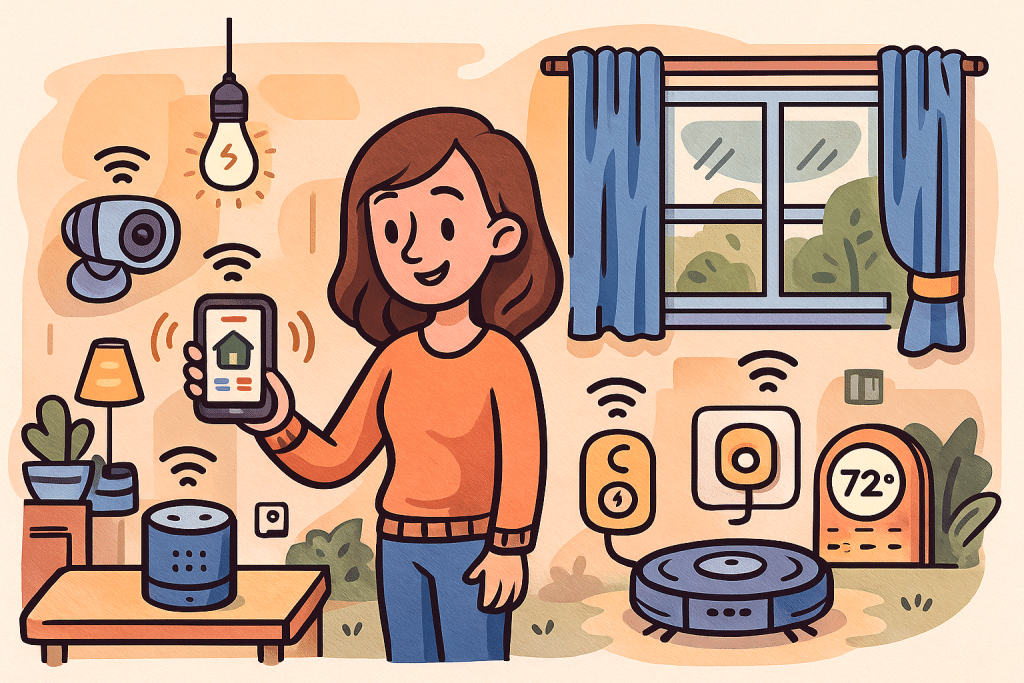
Below, I take you through the key currents shaping the future of smart homes: what’s new, what’s practical, and how you can adopt these trends thoughtfully.
Why 2025 Feels Like a Turning Point for Smart Homes
Before diving into trends, it helps to see the bigger picture:
- The global smart home market is projected to hit USD 162.27 billion in 2025, growing rapidly toward over USD 1,400 billion by 2034.
- Analysts see that the next wave is no longer about adding more devices, but about how they talk to each other, how they anticipate your needs, and how they hide complexity behind smooth user experience.
- As consumers shift from novelty to reliability, adoption depends on three pillars: interoperability, intelligence, and low latency/local control.
So, what are the smart home integration trends that deserve your attention? Let’s break them down.
1. Matter 1.4 and the Rise of True Interoperability
Why interoperability has been the missing link
Historically, one of the biggest frustrations in smart homes was that devices from different brands frequently couldn’t communicate well. You might have Zigbee bulbs working with one hub, Wi-Fi plugs tied to another app, and a smart lock that refuses to appear in your primary automation routines.
That changing: Matter is a connectivity standard designed specifically to unify diverse ecosystems, letting devices from different manufacturers interoperate over IP-based networking.
What Matter 1.4 adds (and why it matters)
Updating to Matter 1.4 is a key shift in 2025. The new spec expands support for more kinds of devices—including water heaters, heat pumps, solar arrays, battery systems, and more nuanced load control.
For example, Samsung’s SmartThings platform now supports Matter 1.4, allowing water heaters and solar setups to join your existing automation routines.
This means that your energy systems, HVAC, and major appliances can now participate in your smart home logic, not just your lighting or sensors.
How to take advantage
- When choosing new devices in 2025, prioritize Matter‑certified or Matter‑upgradeable products.
- Consider migrating your central hub or platform to one that supports Matter 1.4 or at least 1.3+.
- As more devices participate, your scenes and automation become more meaningful (e.g., turning off the pool pump when solar output dips, or preheating your home in concert with energy schedules).
By enabling cross‑device coordination, this interoperability shift is one of the clearest examples of smart home integration trends at work.
2. AI-Driven Personalization: From Schedules to Anticipation
Moving beyond rigid rules
Traditional smart homes rely heavily on manually defined rules: “If motion sensor triggers after 8 p.m., turn on light.” That works, but it’s brittle when your schedule changes (vacations, work shifts, unpredictable days).
Enter AI-driven personalization. Systems now increasingly learn from your behavior and proactively make adjustments.
In research, combining large language models (LLMs) with user preferences has shown boosts in automation quality, responsiveness, and comfort, reducing latency and improving relevance.
Similarly, a recent study coupling LLMs with Home Assistant shows that LLMs can generate smarter automations (though still facing syntax and safety challenges).
Practical examples in 2025
- A smart thermostat that not only follows a schedule but learns when you come and go, outdoor temperature, and occupancy trends to preheat or cool just right.
- Lighting that adjusts color temperature and brightness based on time of day, user activity (reading, relaxing, working), and ambient light levels.
- Generative routines: You speak a command in natural language (“Get me ready for bed”) and a system translates that into multi‑device actions (dim lights, lock doors, set thermostat).
Tips for adoption
- Start with a smart home controller/hub that supports AI-based automation (e.g. Home Assistant, SmartThings, etc.).
- Feed it good data: occupancy sensors, motion detectors, even wearable integration.
- Monitor what actions are suggested and fine‑tune misfires—AI learns better with feedback.
- Always retain manual override options; the goal is assistance, not replacement.
This shift toward intelligent behavior is a core part of smart home integration trends in 2025.
3. Local and Offline Voice Intelligence (Low Latency, Privacy First)
Why cloud-based voice is a bottleneck
Many current voice assistants send your voice to cloud servers, wait for processing, and return commands. That introduces latency, dependency on connectivity, and privacy risks. As noted in a recent proposal, this architecture consumes extra energy and suffers from a lack of responsiveness.
To address this, researchers propose embedding offline speech recognition and keyword spotting directly into local devices. This means faster responses, fewer failures, and greater autonomy.
What local voice systems may look like
- Smart speakers or edge devices that can process basic voice commands entirely locally (“turn lights off,” “lock front door”)
- On‑device language models for more complex commands, possibly combining with local knowledge
- Fallback or escalation to cloud only when needed
Real-world traction
While fully local voice is still nascent, companies are pushing in this direction. The goal is for voice to be fast, reliable, and available even when internet connectivity is weak.
If you combine local voice with AI-based automation and Matter interoperability, you get a system that can respond immediately, act intelligently, and coordinate across devices.
This is a more advanced layer of smart home integration trends that moves beyond reactive commands into embedded intelligence.
4. Energy Automation & Home Grid Response
Why energy is now part of integration
With rising electricity costs and growing emphasis on sustainability, smart homes are no longer just about comfort—they’re about managing consumption. Many homes are now adding solar panels, battery storage, and demand response systems.
Smart homes in 2025 are expected to orchestrate these systems in real time: choosing when to charge batteries, when to draw power from the grid, and when to shed or shift loads—all in harmony with your comfort preferences.
Examples of integrated energy control
- If your solar output spikes midday, a smart system might pre‑cool or preheat the home, or run your dishwasher or washing machine.
- During peak grid demand, the system may dim nonessential lighting or delay appliance start times.
- The integration with HVAC, lighting, smart plugs, and appliance scheduling becomes fluid; your home reacts as a single organism, not disparate parts.
Because Matter 1.4 now supports devices like water heaters and solar systems, the energy domain is becoming a first-class citizen in automation.
What to do if you’re interested
- If you have or plan solar + battery, choose controllers and inverters that speak open protocols (e.g. Modbus, MQTT, or Matter‑compatible)
- Use smart plugs/lights/appliances that can accept dynamic signals (e.g. adjust power usage, delay start)
- Combine with AI-based rules so the system can adapt, rather than sticking to fixed schedules
This energy orchestration is one of the most transformative aspects of smart home integration trends today.
5. Ambient Sensing, Presence Detection & Context Awareness
What ambient intelligence means
Ambient sensing refers to using sensors embedded in the environment to sense presence, motion, room occupation, or even gestures—without needing wearable devices. It helps systems understand context: “Is someone in the room? Where are they? What are they doing?”
This intelligence lets your home behave proactively—turning off lights in empty rooms, adjusting climate per occupancy, or pausing music when you leave.
Emerging capabilities
- Motion sensors, radar sensors, ultrasonic sensors, or even cameras (processed locally)
- Use of presence detection to trigger context-aware routines
- Gesture sensing (e.g. waving to turn off lights) as a supplement to voice or button control
These sensors feed the AI engine and make automation smarter, forming another pillar in smart home integration trends.
Suggested Step-by-Step Guide: Implementing These Trends in Your Home
Below is a suggested roadmap to gradually adopt these 2025 trends so your home becomes smarter, not more chaotic:
- Audit your current smart devices
- List them and note whether they are Matter‑certified or upgradeable.
- Identify gaps: e.g. no occupancy sensors, no energy-aware devices, weak integration.
- Choose a hub or central system that supports Matter 1.4 and AI routines
- Home Assistant, Samsung SmartThings, or other open frameworks
- Make sure it supports local automations and doesn’t force cloud dependency.
- Upgrade or add devices with interoperability in mind
- Start with lighting, switches, smart plugs, sensors
- Then move into HVAC, battery/solar, and major appliances
- Introduce ambient sensors and presence detectors
- Place motion sensors in unused rooms
- Use local occupancy detection to refine automation
- Train and refine your AI routines
- Let the system gather usage data
- Correct misfires, refine triggers
- Gradually rely more on predictive behavior
- Integrate energy systems if applicable
- Add smart load controllers
- Use dynamic routines to balance grid usage or solar availability
- Add local voice processing where possible
- Try devices that can operate without cloud fallback
- Combine voice control with automation for redundancy
- Monitor, review, and iterate
- Check logs or dashboards weekly
- Note what works, what surprises you
- Continue evolving your system
If done stepwise, you can avoid overwhelming integration and ensure each new layer adds value.
Potential Challenges & Mitigations
| Challenge | Why it matters | Mitigation |
|---|---|---|
| Legacy devices without Matter support | Many older devices can’t join the new interoperability ecosystem | Use bridges/hubs that convert non-Matter protocols, or gradually phase out unsupported devices |
| Security and privacy risks | More connectivity means more exposure | Use strong passwords, enable device-level encryption, isolate IoT network separate from critical data |
| AI mistakes or over‑automation | Incorrect triggers can frustrate you | Always allow manual override, review routines periodically, allow “undo” behavior |
| Network bandwidth & latency issues | Too many devices strain Wi-Fi / routers | Use wired backbone where possible, add mesh/enterprise-grade routers, segregate IoT traffic |
| Overcomplexity creep | Your system might become too tangled | Keep simplicity in mind—start small, modularize, document your automations |
These risks are part of the journey and can be managed with thoughtful planning.
The Real Benefit: Smarter Living, Less Friction
What does it feel like to live in a home aligned with these smart home integration trends?
- Lights adjust without your command, based on your movement and time of day
- The thermostat works quietly in the background, adapting to your comfort needs
- Your solar/battery system shifts power usage seamlessly
- You ask “good night” and the house locks, dims, and preps climate
- When energy prices spike, your home nudges you with suggestions or automatic shifts
In short, the goal shifts from control to assistance: the smart home fades into the background, yet helps you in daily life.
References
- “How Smart Home Gadgets are Enhancing Daily Life,” The Boss Magazine, 2025. Available at: https://thebossmagazine.com (accessed 2025)
- “Benefits and Barriers Associated with the Use of Smart Home Health Technologies,” BMC Geriatrics, 2024. Available at: https://bmcgeriatr.biomedcentral.com (accessed 2025)
- Chen, X., Miller, C., Goutham, M., Hanumalagutti, P., Blaser, R., & Stockar, S. (2023). “Development and Evaluation of an Online Home Energy Management Strategy for Load Coordination in Smart Homes with Renewable Energy Sources,” arXiv preprint. Available at: https://arxiv.org (accessed 2025)

 Steps to Launch a Successful Side Business