Interior Decor Ideas That Maximize Function
Thomas Blake October 2, 2025
In today’s homes, where space is scarce and expectations are high, multifunctional decor ideas are no longer just clever — they’re essential. This article shows you how to transform your space with design that works as hard as you do.
Why multifunctional decor ideas are surging now
Across cities worldwide, people are living in smaller homes, apartments, or hybrid workspaces. As a result, interior design is evolving from purely aesthetic to deeply utilitarian. The global multifunctional furniture market itself was worth USD 15.9 billion in 2024 and is projected to grow at a compound annual growth rate (CAGR) of 4.9% from 2025 to 2034.
Design trend reports also note that multifunctional furniture is one of the key interior design trends to watch in 2025. As more people demand that their décor be “smart,” adaptive, and space-efficient, the intersection of form and function is becoming a battleground for innovation.
In short: the era of one‑function sofas, chairs, and tables is yielding to designs that fold, expand, hide, or shift with need. If your home is going to feel larger, more relaxed, and more capable, embracing multifunctional decor is one of the best bets for this year and next.
So let’s look at how to deploy these ideas in your home — meaningfully, stylishly, and with real impact.
1. Modular & transformable furniture: the foundation of flexible space
A core strategy in multifunctional decor ideas is modular design — furniture that can be rearranged, expanded, or collapsed on demand.
• Convertible sofas / sectionals
These are among the most obvious but still underutilized. Sofas that unclip and re-form or include pull‑out beds strike a balance between lounging and sleeping without doubling your footprint.
• Extendable tables & nesting pieces
A dining table that folds or extends when guests arrive, or nested side tables that slide in and out, let you scale your footprint up or down based on context.
• Modular shelving & walls
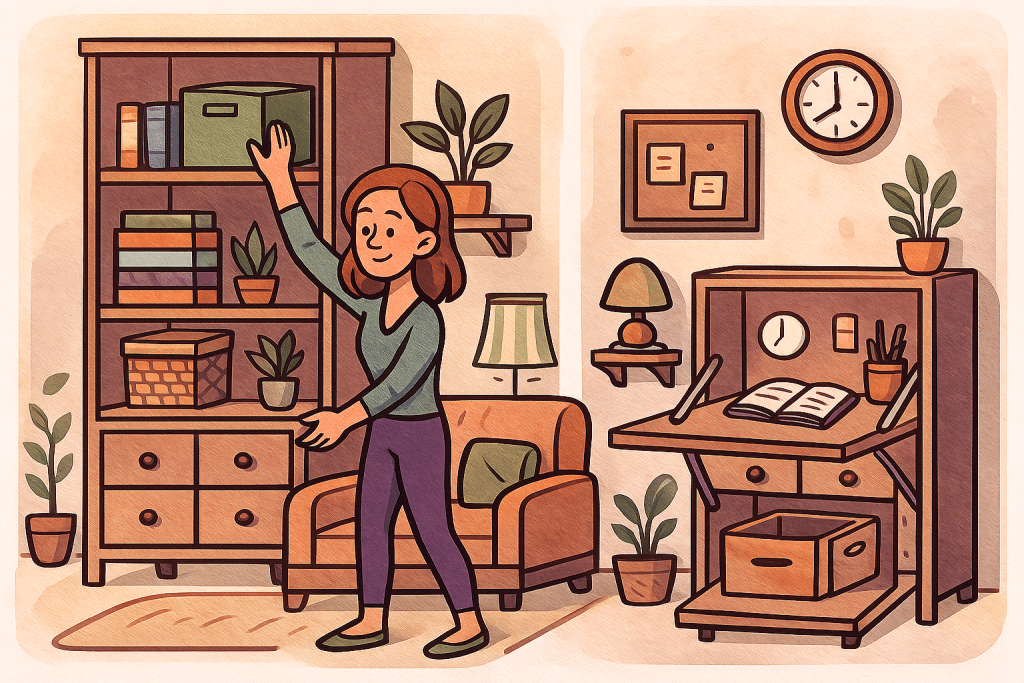
Open shelving cubes, modular wall units, or even sliding partitions can help you reconfigure your storage and room divisions as your needs shift — e.g. turning a living room into an impromptu office zone.
These modular approaches align with predictions that “customizable furniture, modular designs, and adaptable decor will dominate” in coming years.
Pro tip: When selecting modular pieces, look for neutral finishes or consistent lines so different configurations still look coherent. Always test how easy it is to move or reconfigure — heavy modular parts defeat the purpose.
2. Hidden storage and “secret” compartments
One of the most satisfying moves in multifunctional decor is creating stealthy storage that doesn’t look like storage.
• Lift-top sofas, ottomans & benches
Pieces where the top lifts to reveal storage are practical for stashing throws, games, or office gear without clutter.
• Beds with drawers or hydraulic lift
Under-bed drawers or mattresses that lift to expose storage can eliminate the need for separate dressers, gaining floor space.
• Staircase & wall niches
If your home has a stairway or vertical expanse, convert treads or risers into drawers, or use wall niches as recessed cabinets. These niche conversions often go unused but are perfect “dead zones” to exploit.
• Concealed cabinetry in unexpected places
Consider inserting a cabinet behind sliding wall panels, within bulkheads, or behind mirrors (e.g. mirror with medicine‑cabinet style depth) — essentially turning decorative elements into storage containers.
Because multifunctional decor ideas emphasize combining utility into every piece, hidden storage helps ensure that even decorative features pull double duty.
3. Integrated tech + smart furnishings
In 2025, multifunctional decor is not just mechanical — it’s increasingly digital or responsive.
• Smart foldable desks / workstations
Desks that fold into wall panels, drop down from cabinetry, or hide in wall niches, paired with motorized lifts or mechanisms, let your office vanish when not in use.
• Adjustable-height surfaces
Tables that adjust for sitting, standing, or dining modes (via electric lift) let one surface serve multiple roles — eating, working, crafting, or gaming.
• Embedded lighting & wireless charging
Furniture with integrated LEDs, wireless charging pads, or power outlets built into side tables or desks reduce reliance on visible cords and extend functionality.
• Robotic or adaptive furniture (emerging)
Cutting-edge research is exploring furniture pieces that can physically move or adjust themselves. For instance, robotic partitions or “gesture‑aware” surfaces may soon shift shape based on occupancy or use. While still niche, these ideas indicate the frontier toward which multifunctional decor ideas may evolve.
4. Layered zones: dual-purpose room planning
Some spaces resist obvious modular furniture. In those cases, design your zones to overlap.
• Overlapping functions
Combine uses in a single zone: e.g. a dining area that doubles as a workspace (using fold-out desk or modular table), or a seating corner that houses extra guest sleeping in a pull-down bed.
• Sliding or retractable dividers
Rather than rigid walls, use sliding doors, pocket partitions, or curtain walls to flex between separate or unified zones as needed.
• Vertical layering
Stack functions vertically: the ceiling region, walls, and floor all become usable zones. For example, overhead shelving above desks, wall-mounted fold-down beds, or ceiling-hung track systems can leverage unused height.
• Flexible lighting & acoustics
Design lighting and acoustic treatments to adjust with the mode (work, rest, entertain). Adjustable task lighting or acoustic panels that shift functionally help the same physical space feel tailored to each use.
5. Multi-use décor: making beauty functional
Don’t separate aesthetics from utility. Use decor elements that themselves fulfill roles.
• Decorative screens that are storage
Screens and room dividers that double as media cabinets, shelving units, or display cases.
• Planters that filter air
Greenery that’s in built planters or structures that also act as partitioning or ambient filtration (biophilic decor with utility).
• Wall panels with hooks, magnetic surfaces, or peg systems
These decorative panels can hold tools, art, or everyday items (e.g. keys, kitchen utensils), making them part display, part organization.
• Floor rugs with hidden grids
Some high-end rugs include embedded patterns or modules that allow placement of modular furniture or storage elements flush to the floor surface.
By design, multifunctional decor ideas require that even “beautiful pieces” carry function.
6. Sustainability meets function: durable, adaptable, eco-first
Functionality is more persuasive when paired with durability and eco-consciousness — a direction many interior design sources emphasize for 2025.
- Choose timeless finishes and durable surfaces (solid wood, metal frames) over disposable trends.
- Select pieces that adapt rather than get replaced — modular designs inherently delay obsolescence.
- Use recycled, reclaimed, or low‑VOC materials to align your functional decor with climate goals.
- Lean on multi-use or upcyclable components that can be reconfigured or repurposed rather than discarded.
When your multifunctional decor lasts and adapts, you maximize not just spatial function but sustainability.
7. Room-by-room multifunctional moves
Here are ideas you can apply directly, depending on which room you’re rethinking.
| Room | Multifunctional Decor Moves |
|---|---|
| Living room | Sofa with storage, pull-out guest bed, nesting tables, media wall that hides equipment |
| Bedroom | Lift-up or drawer storage bed, built-in wardrobes with fold-down desk, wall shelves above bed |
| Kitchen / dining | Drop-leaf or fold-away table, bench seating with storage, rolling kitchen islands |
| Entry / hallway | Wall-mounted fold-down console/desks, narrow cabinets with fold-out surfaces, key/boot storage built into walls |
| Bathroom | Mirror cabinets, vertical shelving, pull-down ironing boards or foldable laundry hampers |
| Home office | Wall mural desks, mobile pods on casters, acoustic partitions that double as bookshelves |
You can pick two or three rooms to retrofit with multifunctional decor ideas, and once you see the flexibility in one, the rest tend to follow.
8. Mistakes to avoid & tips to get it right
- Overcomplexity: A piece may do many things, but if it’s too fiddly or fragile, people won’t use it. Always test mechanical parts.
- Mismatch in style: If the multifunction moves clash with your aesthetic, they’ll always feel like “utility furniture.” Choose styles that integrate with your scheme.
- Ignoring ergonomics: Ensure that fold‑out desks or beds still meet comfortable dimensions when deployed.
- Underestimating weight or maintenance: Moving parts require robust hardware; cheap hinges or sliders can fail.
- Neglecting transitions: Make sure operations are smooth (soft-close, auto-locks) so using them feels crisp, not awkward.
Also, introduce multifunctional decor ideas incrementally — start with the piece you use most (e.g. sofa, bed) and build around that.
9. The future: what’s next in multifunctional decor
The pace of innovation suggests that in the next few years, we’ll see:
- Furniture that learns and adapts automatically (via embedded sensors).
- Materials that self-heal or reconfigure in small shifts, adapting form to need (folding surfaces, memory materials).
- Robotic partitions or transformable walls that shift with time or occupancy (as research in HRI and adaptive architecture suggests).
- Anywhere‑anytime modularity, where digital control (apps or voice) can change a room’s layout in seconds.
In other words, our homes themselves might become more dynamic — furniture with purpose but also with autonomy.
Final thoughts
The shift toward multifunctional decor ideas reflects a deeper change: we now expect our interiors to serve, to adapt, and to disappear when not needed. As homes get denser and lives busier, that shift is no longer optional.
By combining modular furniture, hidden storage, tech integration, layered zones, and durable materials, you can make your space feel bigger, more flexible, and more purposeful — without losing style.
Start small. Replace one piece with a smarter design. Tweak one zone. Then let your home flex itself into something more capable.
Once you begin, you’ll never think of decoration and utility as separate again.
References
- Decorilla. (2024) 20 Top Interior Design Trends 2025: Must-Have Looks You’ll Love. Available at: https://www.decorilla.com/online-decorating/interior-design-trends-2025 (Accessed: 1 October 2025).
- Global Market Insights. (2024) Multifunctional Furniture Market Size Report, 2025–2034. Available at: https://www.gminsights.com/industry-analysis/multifunctional-furniture-market (Accessed: 1 October 2025).
- Home’s Society. (2024) The Future of Home Design: Trends to Watch in 2025. Available at: https://homessociety.com/blog/2024/10/22/the-future-of-home-design-trends-to-watch-in-2025 (Accessed: 1 October 2025).

 Travel Experiences That Combine Adventure and Education