Strategies for Preventive Healthcare in Busy Lifestyles
Emily Ward September 18, 2025
Balancing preventive healthcare in busy lifestyles can feel impossible, but skipping it comes at a cost. With simple, evidence-based strategies, professionals and parents alike can protect long-term health—without overhauling their daily schedules.
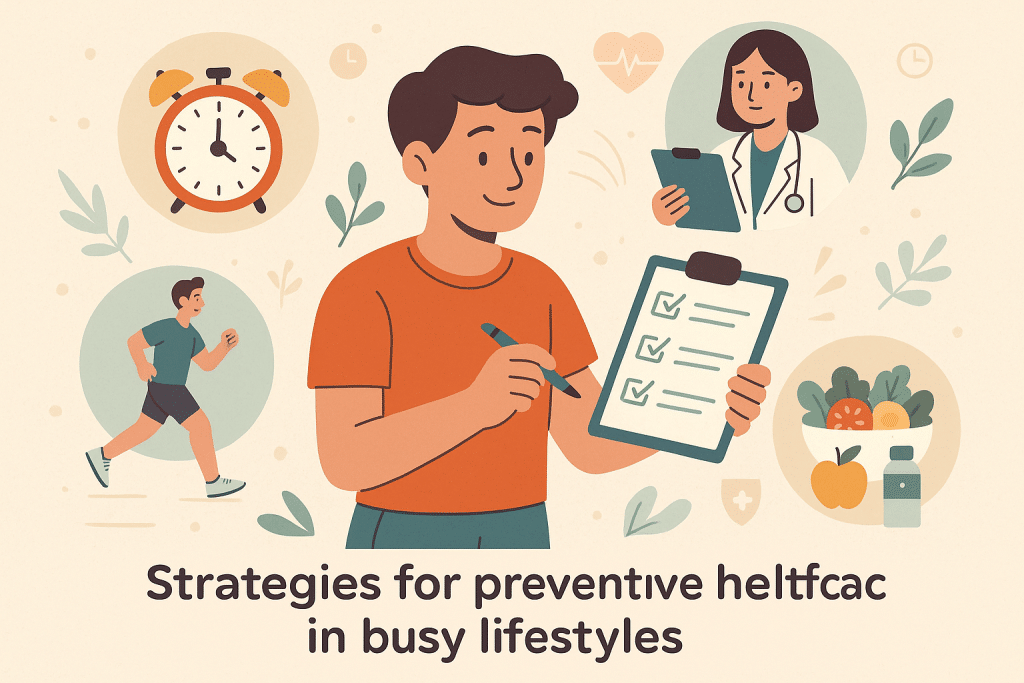
Why Preventive Healthcare Matters More Than Ever
The rise of chronic illnesses linked to sedentary habits and poor diets has made preventive care essential. According to the World Health Organization (WHO), at least 80% of premature heart disease, stroke, and type 2 diabetes could be prevented through lifestyle adjustments (WHO 2023).
In fast-paced environments where people prioritize work over well-being, preventive healthcare becomes the missing link between longevity and daily performance. Unlike reactive care, which starts after illness, preventive strategies proactively maintain balance.
Key Challenges in Busy Lifestyles
- Time scarcity – Professionals often skip checkups or exercise due to packed calendars.
- Digital overload – Screen fatigue contributes to sleep issues, eye strain, and stress.
- On-the-go diets – Fast food replaces balanced meals, fueling obesity and cardiovascular risks.
- Work-life imbalance – Stress levels remain high, weakening immunity and mental health.
Understanding these challenges allows individuals to design preventive routines that fit their reality.
Strategies for Preventive Healthcare in Busy Lifestyles
1. Micro-Workouts: Fitness in Minutes
One of the hottest trends in preventive healthcare is exercise snacking—short bursts of activity spread throughout the day. Studies published in the British Journal of Sports Medicine confirm that even three 10-minute sessions of moderate exercise significantly reduce mortality risks (Ekelund et al. 2019).
Practical ways to add micro-workouts include:
- Taking the stairs instead of the elevator.
- Doing resistance band stretches between Zoom calls.
- Walking meetings instead of sit-down ones.
These quick moves improve circulation, combat stiffness, and maintain cardiovascular health.
2. Smart Nutrition on the Go
Preventive healthcare in busy lifestyles hinges on diet. Meal prepping has gained popularity among professionals, allowing balanced nutrition without time stress. The Harvard T.H. Chan School of Public Health highlights that Mediterranean-style diets reduce cardiovascular disease by up to 30% (Estruch et al. 2018).
Tips for quick nutrition:
- Keep healthy snacks (nuts, fruit, yogurt) at your desk.
- Batch-cook proteins and vegetables for weekly use.
- Choose portable smoothies rich in fiber and protein.
Replacing fast food with structured choices supports energy levels and prevents long-term disease.
3. Scalp and Sleep Health: Overlooked Preventive Care
Stress and poor routines often show up in surprising places—like the scalp. Dermatologists link chronic stress to hair thinning and scalp inflammation, issues preventable with proper care. A 2022 National Institutes of Health (NIH) study found that sleep deprivation worsens both skin and scalp conditions due to hormonal imbalance (NIH 2022).
Preventive steps include:
- Sleeping 7–8 hours nightly with screen curfews.
- Using scalp massages or essential oils to reduce tension.
- Hydration to prevent dryness and flakiness.
By addressing scalp and sleep health, individuals safeguard not only appearance but also immune and nervous system function.
4. Functional Health Monitoring with Technology
Wearables have revolutionized preventive healthcare in busy lifestyles. Smartwatches and apps track heart rate, blood oxygen, and sleep patterns, allowing users to spot irregularities early. According to Forbes Health, more than 30% of U.S. adults now use wearables for preventive monitoring (Forbes 2024).
Key functions include:
- Heart rhythm alerts for atrial fibrillation risks.
- Daily movement reminders.
- Stress monitoring through HRV (heart rate variability).
Technology helps busy professionals take control of health without scheduling multiple doctor visits.
5. Mindfulness as a Preventive Tool
Mental health often takes a backseat in discussions about overall wellness, yet its impact on physical health is undeniable. The American Psychological Association highlights that chronic stress not only impairs mental well-being but also increases the risks of cardiovascular disease and immune dysfunction (APA 2021). This makes stress regulation a vital pillar of preventive healthcare.
Mindfulness, defined as the practice of maintaining present-moment awareness with openness and acceptance, is increasingly recognized as a cost-effective and practical solution for managing stress before it escalates into chronic illness. Research from Harvard Medical School shows that consistent mindfulness practice can significantly reduce cortisol—the body’s primary stress hormone—leading to improved resilience, lower blood pressure, and enhanced immune function (Hölzel et al. 2011).
Unlike medical interventions that address illness after it appears, mindfulness offers a proactive approach that strengthens mental health defenses in advance. Short, simple routines can be woven into even the busiest schedules, making them highly accessible. For example:
- Guided breathing exercises: Just 5 minutes during work breaks can reset the nervous system and improve focus.
- Journaling for emotional awareness: Documenting moods and triggers helps identify stress patterns early.
- Mindfulness apps: Digital tools provide structured, bite-sized sessions ideal for beginners and professionals alike.
Evidence suggests that such micro-practices, when sustained, do more than reduce stress in the moment—they cultivate long-term resilience against burnout, anxiety, and depression (Creswell 2017). Importantly, mindfulness is not limited to personal benefit; workplaces adopting mindfulness programs report reduced absenteeism and higher employee satisfaction, underscoring its potential as a preventive healthcare strategy at both individual and societal levels.
6. Preventive Screenings: Non-Negotiables
Even with digital tools, annual checkups remain irreplaceable. Routine blood work, cholesterol checks, and skin cancer screenings save lives. The Centers for Disease Control and Prevention (CDC) emphasizes that preventive screenings cut healthcare costs by catching diseases early (CDC 2022).
For busy people, telemedicine has made screenings easier. Many clinics now offer at-home kits for colon cancer, cholesterol, and glucose monitoring.
Integrating Preventive Healthcare into a Busy Lifestyle
The key is habit-stacking—attaching preventive actions to existing routines. Examples:
- Meditating right after brushing teeth.
- Doing push-ups after morning coffee.
- Preparing a healthy snack while checking emails.
This seamless integration makes healthy choices automatic.
The Future of Preventive Healthcare for Busy Lifestyle
Emerging innovations point toward more accessible, personalized care:
- AI-driven health apps predicting disease risks.
- Genetic testing kits offering personalized nutrition and fitness advice.
- Corporate wellness programs integrating preventive routines into work schedules.
These solutions align with modern lifestyles, ensuring that preventive healthcare is not an extra task but an integrated habit.
Conclusion
Preventive healthcare in busy lifestyles is not about radical changes—it’s about small, consistent choices. From micro-workouts and mindful eating to scalp care and wearable tech, modern strategies make wellness compatible with demanding schedules.
Ignoring preventive care comes at a cost, but integrating it builds a stronger, healthier future—without pausing life.
References
- Harvard Health Publishing. (2022) Preventive care: Strategies for healthy living. Harvard Medical School. Available at: https://www.health.harvard.edu (Accessed: 18 September 2025).
- World Health Organization (WHO). (2021) Preventive health: Key facts. Available at: https://www.who.int/news-room (Accessed: 18 September 2025).
- Centers for Disease Control and Prevention (CDC). (2023) Preventive healthcare: Why it matters. Available at: https://www.cdc.gov/prevention (Accessed: 18 September 2025).

 How Small Businesses Can Adapt to Market Shifts