Emerging Trends in Entrepreneurship Education
Jonathan Reed October 2, 2025
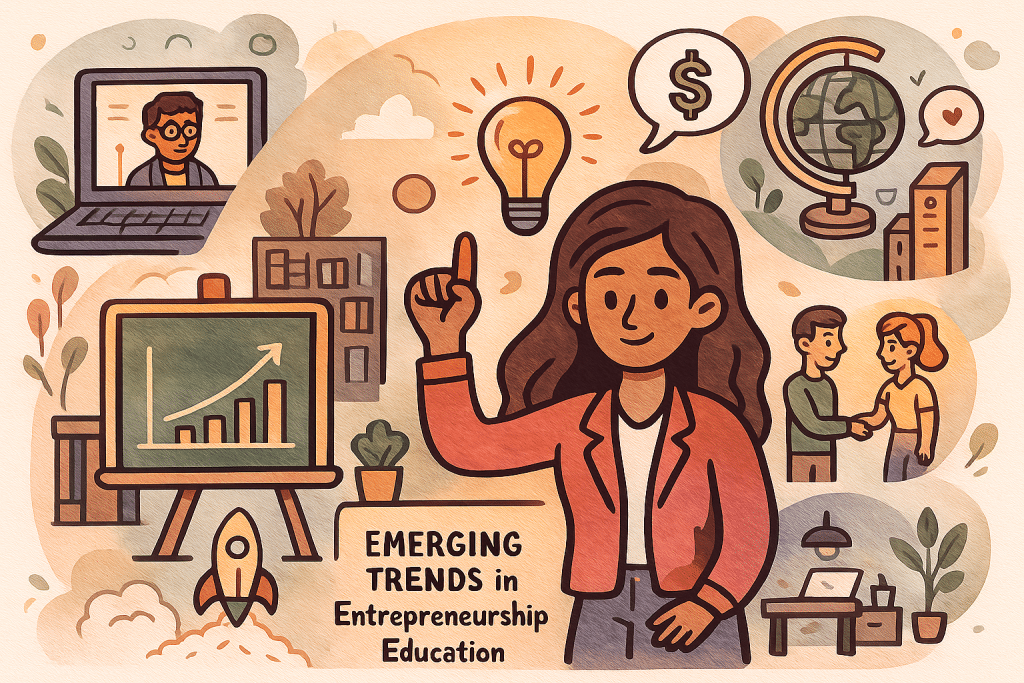
If you’re curious about emerging trends in entrepreneurship education, 2025 is already proving to be a landmark year. From AI‑augmented learning systems to microcredentials and game‑based simulations, new models are shifting how aspiring founders learn to build ventures. This article highlights top trends, practical applications, and how educators and learners can stay ahead.
Why Entrepreneurship Education Is at an Inflection Point
Several forces are converging that make this moment pivotal:
- Rapid advances in generative AI and adaptive tech are enabling more personalized, on‑demand learning experiences.
- The rise of gig economy and necessity entrepreneurship means more learners want practical, venture‑ready skills rather than theory.
- Budget pressures and shifting learner expectations push institutions to adopt leaner, outcome‑oriented models.
- Bibliometric studies show that entrepreneurship education research is evolving rapidly, with emphasis shifting to digital, hybrid, and experiential modes. ([Sreenivasan et al. 2023]
Given this backdrop, educators and program designers are rethinking how to teach venture creation effectively. Below are six of the most promising emerging trends in entrepreneurship education, followed by a look at how to apply them.
1. AI‑Empowered Scaffold Systems for Business Plan Development
One of the most cutting-edge trends in entrepreneurship education is implementing AI‑driven scaffolding systems that guide students through creating plans, validating assumptions, and iterating.
A recent preprint explores exactly this: an AI‑empowered scaffold system for business plan development, which adapts in real time to student progress, suggests resources, flags weak logic, and offers prompts.
Why this matters:
- Reduces cognitive overload by breaking complex tasks into digestible steps.
- Offers personalized support even in large classes.
- Helps bridge the student–mentor gap: AI can monitor consistent progress and flag bottlenecks for human instructors.
Implementation ideas:
- Integrate scaffold modules within entrepreneurship courses, allowing students to receive AI hints or nudges.
- Let instructors configure or override AI suggestions to match pedagogical goals.
- Use scaffold analytics to identify cohorts or modules where many students struggle and adapt curriculum accordingly.
As AI tools mature, they’ll likely shift from auxiliary to core infrastructure in entrepreneurship education.
2. Microlearning & Microcredentials in Lean Startup Curriculum
Traditional semester‑long courses are often too slow and heavy for entrepreneurial learners who want fast, applicable skills. Thus, microlearning modules and microcredentials are gaining ground as compact, focused learning units tied to outcomes.
Exploding Topics recently listed microlearning among the top education trends for 2025–2026. Meanwhile, online education forecasts expect steady growth in modular courses and stackable credentials.
What this looks like in entrepreneurship education:
- Short modules (15–30 minutes) on topics like customer interviews, validating ideas, unit economics, or pitching.
- Stackable badges or certificates: learners earn microcredentials that cumulatively form a full entrepreneurship track.
- Hybrid delivery: microlearning combined with coached sessions, peer review, or project work.
Benefits:
- Learners can consume content in sprints, which fits contemporary attention spans.
- Institutions can update or swap modules rapidly to reflect evolving practice or industry trends.
- Microcredentials may carry employer recognition when designed well.
3. Blended & Hybrid Entrepreneurship Learning Models
The pandemic accelerated online delivery, but fully remote models alone often fall short for experiential learning. That’s where blended or hybrid models rise as a sweet spot. In entrepreneurship education, hybrids mix online coursework with in‑person labs, peer meetings, or pitch events.
A systematic review of online and blended entrepreneurship education found that blended approaches often outperform purely online ones in learner engagement and outcomes.
Hybrid model strengths:
- You can combine the flexibility of asynchronous content with the richness of in-person collaboration.
- Instructors can reserve in-class time for applied activities (workshops, pitches, feedback) rather than lectures.
- Hybrid setups make experimentation possible at scale: theory online, practice in small cohorts.
Design tips:
- Use asynchronous modules as the preparatory “flipped classroom” material.
- Reserve face-to-face (or live sessions) for interactive tasks: prototyping, peer review, mentorship.
- Foster a digital–physical loop: students bring insights between online and in-person phases.
4. Gamification & Business Simulations as Core Curriculum
Rather than reading about business models in theory, tomorrow’s entrepreneurs expect immersive, simulated environments where they can test decisions in compressed time.
In high school and university contexts, entrepreneurship education is already embracing digital business simulations, gamified modules, and scenario-based challenges.
Why it’s trending:
- Games and simulations let students see consequences of decisions (pricing, marketing, scaling) in a sandbox.
- They encourage experimentation, failure, and learning in low-risk settings.
- Engagement naturally increases when learners feel agency.
Ways to incorporate:
- Use ready-made simulation platforms (ERPsim, SimVenture, etc.) integrated into courses.
- Create challenge weeks: cohorts compete on simulated metrics like market share, profitability, user growth.
- Combine simulation output with reflective journaling: “Why did I fail? What assumptions did I neglect?”
5. Data‑Driven Analytics & Learner Insights
As entrepreneurial education becomes more digitized, institutions are able to gather rich analytics on learner behavior, progress, bottlenecks, and outcomes. These generate feedback loops to continuously refine curricula.
A bibliometric analysis focusing on digital entrepreneurship education confirms growing research interest around analytics, feedback systems, and adaptive learning.
Applications:
- Track module drop-offs, quiz performance, scaffold usage, and correlate with student outcomes.
- Use analytics to detect which cohorts need extra support or where content is underperforming.
- Offer adaptive pathways: if a learner struggles with financial modeling, route them through extra scaffold modules or supplementary videos.
The key is not just gathering data—but designing feedback loops to act on it.
6. Focus on Social & Sustainable Entrepreneurship in Curriculum
Students increasingly expect entrepreneurship to address environmental, social, and equity challenges—not just profit. In fact, younger founders tend to design new ventures around social impact by default.
At the same time, many entrepreneurship education programs are weaving social enterprise, impact investing, and mission-driven ventures into their core courses.
Why this shift matters:
- It aligns with learner values and purpose-driven careers.
- It opens doors to grants, funding, and partnerships that reward triple-bottom-line ventures.
- It builds bridges with nonprofit, public, and hybrid sectors.
How to integrate:
- Include case studies of successful social ventures.
- Challenge students to design MVPs that meet both market and social/environmental metrics.
- Pair with local NGOs, social enterprises, or community problems to ground theory in real needs.
How Educators & Learners Can Leverage These Trends
Here are actionable steps for program designers, instructors, and entrepreneurial learners:
For Educators / Program Designers
- Pilot AI scaffolding modules in one course before scaling. Evaluate effectiveness and student feedback.
- Modularize your curriculum into bite‑sized units and create stackable credentials or badges.
- Blend formats—move lectures online to free up in-class time for active work.
- Adopt simulation tools and integrate them with assessments and reflection.
- Build analytics dashboards to monitor learner engagement and iterate components.
- Infuse social impact themes so entrepreneurship becomes more relevant and ethically grounded.
For Learners / Aspiring Entrepreneurs
- Enroll in courses that offer microlearning modules (short, outcome-focused).
- Seek programs that provide AI‑guided feedback or scaffolding tools.
- Prefer blended models: do online work plus face-to-face labs or mentoring.
- Practice with business simulations or gamified platforms to test assumptions.
- Track your learning metrics—module completion, quiz results, project feedback—and adjust your path.
- Explore venture ideas with social or ecological purpose, and include those dimensions in your pitch.
Challenges & Considerations
- Technical access & equity: AI systems, simulation platforms, or analytics require infrastructure—some regions or institutions may be under‑resourced.
- Overreliance on tech: Tools should support, not replace, human mentorship, peer interaction, and real-world validation.
- Quality assurance: Microcredentials and gamified systems must maintain academic rigor and alignment with learning goals.
- Data privacy & ethics: Analytics and AI scaffolding need transparent policies, safeguards, and ethical oversight.
- Change management: Faculty may resist shifting away from traditional methods. Training and incentives are essential.
Conclusion
The landscape of emerging trends in entrepreneurship education is richer and more dynamic than ever. With artificial intelligence scaffolding, modular microlearning, blended models, gamified simulations, data analytics, and a stronger focus on purpose-driven ventures, the next generation of entrepreneurial learners can experience more targeted, effective, and meaningful education.
Whether you are designing a course, running an incubator, or learning on your own, you can adopt pieces of this emerging ecosystem to sharpen your impact. You don’t need to implement every trend at once—pick what matches your resources and learner profile, iterate, and grow.
References
- Zhu, J. & Luo, L. (2025) Designing the Future of Entrepreneurship Education: Exploring an AI‑Empowered Scaffold System for Business Plan Development. arXiv preprint. Available at: https://arxiv.org/abs/(Accessed: 2025).
- Ngcobo, N. (2025) Exploring Entrepreneurship Education: Trends and Student Performance, Entrepreneurship 15(2). Available at: https://www.mdpi.com/ (Accessed: 2025).
- Chen, L. et al. (2021) Online and blended entrepreneurship education: systematic analysis of research, PMC. Available at: https://pmc.ncbi.nlm.nih.gov/articles/ (Accessed: 2025).

 Fitness Challenges That Encourage Daily Movement