Emerging Trends in EdTech and Online Learning
Clara Mitchell September 30, 2025
In 2025, generative AI in online learning is no longer fringe—it’s reshaping how students engage, instructors teach, and platforms evolve. In this article, we look at how this trend works, where it’s heading, and how you can tap into it.
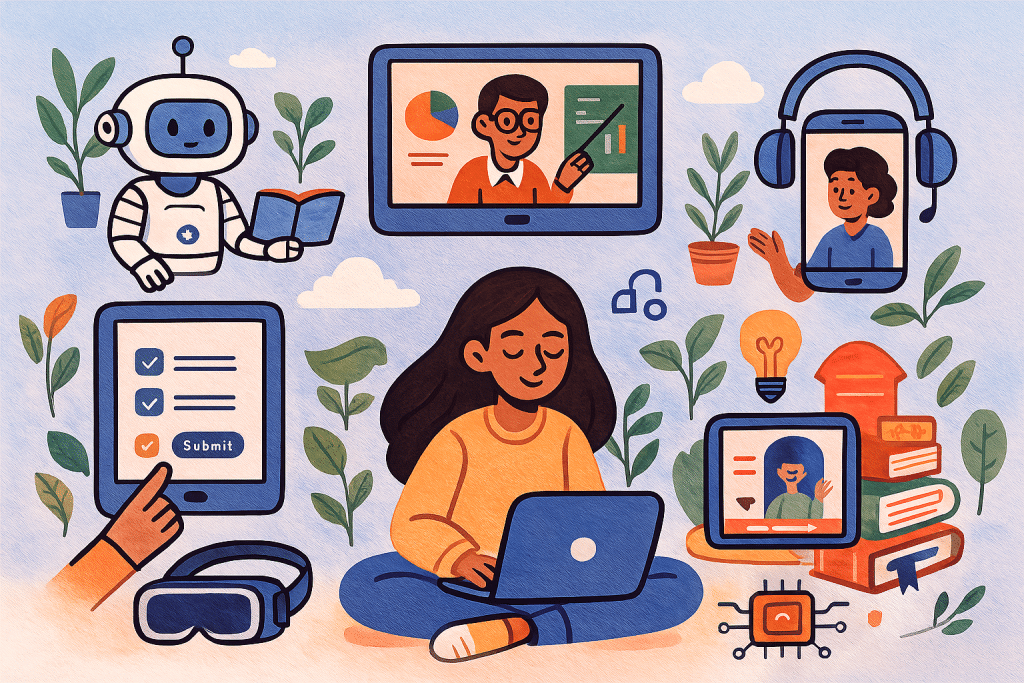
Why Generative AI Is the EdTech Trend to Watch
The shift from adaptive to generative models
Adaptive learning systems have long helped tailor pathways by selecting content based on past performance. But generative AI takes it further: it can create content—explanations, quizzes, summaries, even video scripts—on the fly. The result is far more fluid, personalized, and responsive learning.
- In one recent study, AI‑generated synthetic videos were found to produce learning gains comparable to traditionally produced instructor videos, with learners reporting similar satisfaction levels.
- Platforms like Learn Mate are already leveraging large language models (LLMs) to produce real‑time personalized learning plans and contextual support based on students’ behavior.
This move toward generative AI in online learning is part of a broader push: tools aren’t just selecting what’s prebuilt; they’re inventing new content as needed.
The demand side: what learners expect
Learners today expect every digital experience to be responsive and personalized—whether in newsfeeds, entertainment, or shopping. That expectation is spilling into education.
- A 2025 survey suggests that about 86 % of students now use multiple AI tools in their school work.
- Meanwhile, many online learning providers already embed AI tools for planning, feedback, and content generation.
As users grow more familiar and comfortable with AI in everyday tools, their tolerance for “static” lessons or rigid content may shrink. Generative AI in online learning offers a chance to stay ahead of that expectation curve.
How Generative AI Is Showing Up Today
Let’s break down some of the concrete use cases taking shape now.
1. Auto‑generated course modules, quizzes, and explanations
Instead of instructors having to manually craft every quiz or explanation, generative AI can dynamically produce them based on a student’s current level or confusion zones. This reduces content development burden while keeping material fresh and adaptable.
2. Conversational tutors and assistive chatbots
Beyond simple FAQ bots, generative AI tutors can dive deeply into subject matter, respond with explanations, follow-up questions, and guide students through problem-solving steps. These “AI tutors” adjust their responses based on context and previous interactions.
3. Synthetic media: video, narration, avatars
Generative AI isn’t limited to text. In controlled trials, AI‑generated video (with virtual presenters) achieved comparable learning outcomes to traditional video. As rendering costs fall, we may see more avatars or virtual instructors dynamically generated to suit language, accent, or cultural context.
4. Dynamic personalization and scaffolding
Because generative models operate at a fine granularity, they can scaffold learning—introduce hints, gradually fade support, or pivot explanation style (e.g. from visuals to narrative) depending on user progress. The Learn Mate system is a recent example built around this idea.
5. Real-time content remixes and translation
If a student is struggling in one region or in a particular style, generative AI can remix content (change order, examples, metaphors) or translate it into another dialect or language on the fly. This enhances accessibility and localization.
Opportunities and Risks
Opportunities
- Scalability for instructors and institutions
Generative AI helps reduce the manual effort for content creation, updates, and student-specific adjustments, freeing instructors to focus on mentorship and assessment oversight. - Greater personalization
Because content can be created or adapted continuously, learners receive more precise support during weak points, potentially improving retention and mastery. - Accessibility and localization
AI can translate or adapt content for different languages, reading levels, formats (audio, text, video), making learning more inclusive. - Cost efficiency over time
Once systems are in place, marginal cost of generating additional content is low relative to manual creation.
Risks and challenges
- Quality, accuracy, and hallucination
Generative models sometimes produce incorrect or misleading content (“hallucinations”). Without careful oversight, learners could absorb misinformation. - Bias and fairness
AI models may reflect biases from training data, disadvantaging certain groups or language varieties. - Intellectual property concerns
Are AI-generated explanations or media derivative of copyrighted work? Legal frameworks are still catching up. - Overreliance and deskilling
If students always lean on AI, their ability to deeply think, analyze, or struggle productively might erode. - Privacy, data security, and ethics
These systems require fine-grained data about student behavior and progress, which introduces heightened privacy and security requirements (especially for minors).
In short, generative AI in online learning opens powerful new possibilities—but institutions will need guardrails, review workflows, and strong governance.
What This Means for Educators, Providers & Learners
Instructional designers and teachers
- Rethink your role: you may move from content creator to curator, quality controller, mentor.
- Develop validation workflows: always review AI‑generated modules before release, ensure correctness, alignment with learning goals.
- Build feedback loops: gather student feedback to correct generation errors and refine prompts.
- Train AI literacy: teachers need to understand capabilities and limitations of generative tools.
Edtech platform developers
- Embed prompt engineering capability and guardrails (e.g. “AI must cite sources,” “no hallucinated content”).
- Provide transparency: show students when content is AI-generated, allow explainability or revision history.
- Layer modularity: allow human override, blending AI and human content.
- Monitor usage and drift: as models evolve, track for unintended shifts or biases over time.
Learners
- Use generative tools as co-pilots—not crutches. Ask follow-up questions, cross-check sources.
- Report errors or odd outputs—in platforms that allow you to flag or rate AI content.
- Choose platforms that explain their AI policies: how they validate, where they store data, etc.
A Look Ahead: What’s Next
Emotion‑aware and affective AI
Generative AI may evolve to detect learner emotions—frustration, confusion, boredom—and respond adaptively (e.g. slow down, change tone, provide encouragement).
Hybrid models and human‑AI teaming
Rather than full automation, a middle ground will likely emerge: AI drafts content, then human experts review, refine, and intervene when needed. This hybrid model helps combine scale and accuracy.
AI literacy as core curriculum
As generative AI becomes embedded in education, understanding its strengths, limits, ethics, and mechanics will itself become a learning objective (especially in K‑12). The Active AI project is one recent initiative exploring large-scale AI literacy for K‑12 users.
Regulation, standards, and certification
To manage safety, quality, and equity, educational bodies (governments, accreditation agencies) may begin issuing guidelines or standards for AI in learning—e.g. requiring source attribution, bias audits, review thresholds, or student rights to “human fallback.” UNESCO has already highlighted the need for policy frameworks to keep pace with AI in education.
Smarter multimodal generation
We may see tools that simultaneously generate text, video, interactive simulations, animations, and assessments in a coherent package—based on a single prompt—to produce full lessons on the fly.
How to Start Experimenting Today
- Pick a small pilot area
Choose one module or course area with well-defined scope (e.g. algebra, cell biology) to integrate generative enhancements. - Define evaluation metrics early
Decide ahead what success means—accuracy of generated content, student satisfaction, completion rates, etc. - Use reputable LLM or AI engines
Leverage existing models and APIs (e.g. GPT family, open models) rather than building from scratch initially. - Insert human checks
Ensure AI outputs are reviewed before student release in your pilot. Collect corrections and feedback. - Collect data, iterate fast
Monitor where AI outputs fail, common patterns, student feedback, then adjust prompt templates or constraints accordingly. - Communicate with learners
Be transparent that some content is AI‑augmented. Encourage learners to flag or question dubious outputs. - Scale gradually, with guardrails
Once your pilot demonstrates stability and quality, expand to related modules. But always retain oversight and audit mechanisms.
Conclusion
Generative AI in online learning is not just the next step — it’s a paradigm shift. Instead of rigid, prebuilt lessons, we are moving toward systems that can genuinely adapt, create, and respond in real time. The promise is greater personalization, efficiency, and accessibility. But success will depend on how carefully we manage quality, ethics, and human oversight. For educators and edtech builders, the time to experiment is now, with eyes wide open and testing frameworks ready.
References
- HolonIQ. (2022) Global EdTech Market to Reach $404B by 2025. Available at: https://www.holoniq.com (Accessed: 29 September 2025).
- World Economic Forum. (2020) The COVID-19 pandemic has changed education forever. This is how. Available at: https://www.weforum.org (Accessed: 29 September 2025).
- EDUCAUSE. (2023) 2023 Horizon Report: Teaching and Learning Edition. Available at: https://library.educause.edu (Accessed: 29 September 2025).

 Travel Destinations That Combine Culture and Nature