Emerging Trends in Global Trade and Commerce
Jonathan Reed September 22, 2025
In 2025, AI global trade is no longer a sci-fi prediction—it’s a force accelerating how goods move, how services are delivered, and how countries compete. From enforcing carbon rules on imports to speeding up compliance and digital trade deals, AI is changing the rules of the game.
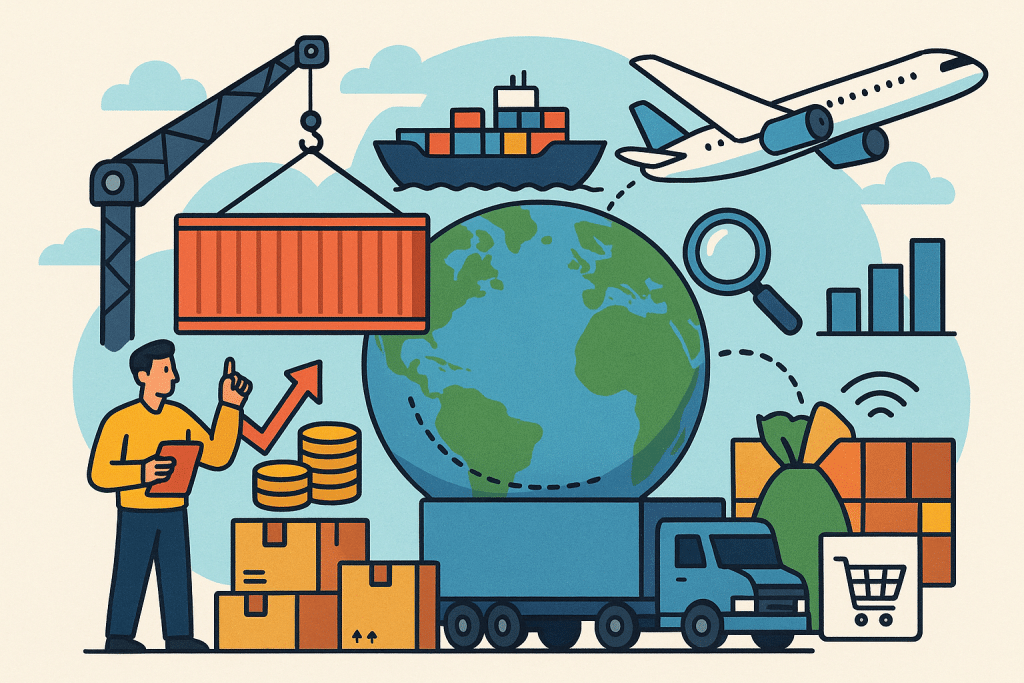
Why AI global trade is suddenly center stage
Several converging pressures are pushing global trade toward AI dependence:
- Rising costs and complexity: Geopolitical tensions, inflation, and disrupted supply chains (e.g. after COVID-19, war, etc.) make traditional trade routes and systems fragile. Governments and businesses are under pressure to reduce delays, costs, and risk.
- Regulatory headwinds: New rules like the EU’s Carbon Border Adjustment Mechanism (CBAM) force exporters to account for emissions embedded in their goods. Accurate reporting, data gathering, and verification become essential. AI tools help with monitoring, estimation, and even predictive compliance.
- Digital trade momentum: Agreements (digital trade agreements, DTAs) are now covering data flows, cybersecurity, e-signatures, digital taxation, etc. AI and associated technologies help manage, secure, and audit these flows.
Key ways AI global trade is transforming the landscape
Here are major areas in which AI is now altering global trade dynamics, with real implications for businesses, governments, and economies.
1. Smarter logistics & supply chain resilience
- Predictive analytics: AI models can forecast disruptions (weather, labor strikes, political unrest) and allow rerouting or reallocation of inventory in advance.
- Automation & robotics: Warehousing, packaging, loading/unloading are increasingly automated, reducing human error, speed delays.
- Digital twins and monitoring: Real-time tracking of goods, conditions (temperature, humidity, handling) using sensors + AI helps reduce spoilage, guarantee quality.
These systems improve reliability, lower costs, reduce waste. For many companies, supply-chain risk is now central to trade strategy.
2. Regulatory compliance & environmental transparency
- Emissions reporting & CBAM: The EU’s CBAM means exporters must report greenhouse gas footprints of their products exported to the EU; AI helps estimate, verify, and reduce those emissions.
- Real-time monitoring: Satellite imagery, sensor data, AI pattern recognition help enforce environmental regulations, detect deforestation, pollution, or illegal resource extraction tied to trade.
3. Digital trade agreements & cross-border data flows
- New trade treaties focusing on digital economy: DTAs cover rules about data localization, privacy, e-commerce, digital customs, cybersecurity. AI tools help companies comply with varied juridical requirements in different markets.
- Smart customs / border processing: AI and machine learning speed up customs declarations, detect anomalies (fraud, smuggling, tariff evasion), and automate risk scoring.
4. Competitive shifts & inclusion challenges
- Small producers benefit if digital infrastructure is strong: Producers in lower-income countries who adopt digital tools can reach global markets more efficiently; AI aids in translation, demand forecasting, matching with buyers.
- Risk of widening gaps: If infrastructure, regulation, or capital are lacking, AI can exacerbate inequality—countries or firms without access may be left behind. WTO warned that unless digital infrastructure improves, emerging markets might gain less from AI trends.
Case in point: EU’s Carbon Border Adjustment Mechanism & AI
Since CBAM is becoming law, let’s see a concrete example of how AI global trade plays a role:
- CBAM will require importers into the EU of certain high-emission goods to buy permits tied to their embedded emissions. This means exporters must accurately measure/estimate emissions along complex upstream production chains.
- AI tools can help with data interpolation, estimation of emissions in energy usage, transport, materials sourcing. Machine learning models can predict or fill gaps when suppliers do not have full records.
- Also, AI can help exporters simulate alternate supply chains (e.g., sourcing cleaner energy, using less carbon-intensive materials) to reduce CBAM costs proactively.
This trend creates both cost (adjust investments & operations) and opportunity (firms that move early might gain competitive advantage, access to EU markets with less friction).
What businesses and countries need to do: A practical guide
If you want to stay ahead of AI global trade, here are strategic moves to consider:
- Invest in data collection & infrastructure
- Deploy sensors, IoT devices to capture data on emissions, health of produce, shipping conditions.
- Digital record-keeping systems; ensure data is trustworthy (blockchain / auditable platforms).
- Adopt AI and predictive tools
- Risk forecasting for supply chain delays.
- Automated compliance tools to track regulatory changes and flag non-compliance.
- Engage in trade agreements / policy discussions
- Be aware of digital trade rules in your export markets.
- Lobby or collaborate to shape fair regulations (especially for developing countries to have fair transitions).
- Diversify & build resilience
- Maintain multiple suppliers; regionalize supply chains where possible.
- Simulate scenarios (e.g. carbon costs, border delays) and optimize accordingly.
- Build skills and governance
- Train staff in data analysis, AI tools, sustainability reporting.
- Establish governance for data privacy, ethical AI, environmental compliance.
Challenges and what could go wrong
While AI offers large potential, risks include:
- Data gaps and accuracy: Some suppliers may not have data; estimating emissions or compliance may be technically difficult.
- Regulatory fragmentation: If different countries have very different rules for AI, data flows, emissions, this increases compliance cost.
- Cost of technology: Initial investment is high; small firms may be unable to afford premium tools or infrastructure.
- Trade protectionism under guise of environmentalism: Some see CBAM-like policies being used as trade barriers rather than genuine environmental instruments. Developing countries could be penalized.
What the near future may look like (2025–2030)
- AI will be increasingly embedded at every stage: from farm to factory to port, to dock to retailer.
- Trade policy will evolve: more digital trade agreements, standardized emissions/reporting rules, global norms for AI tools in trade.
- Firms that adapt early will have better margins, fewer regulatory penalties; laggards will face rising costs, blocked market access.
- Possible emergence of “green/low-carbon trade blocs” or preferential terms for low-emission exporters.
Conclusion
The rise of AI global trade marks a shift in how we think about international commerce. It’s not just about tariffs or shipping lanes anymore—it’s about emissions credentials, data flows, compliance, resilience.
If you’re a business exporting goods, a policymaker, or simply tracking the future, embracing AI and the related trends now will likely define who wins or falls behind in the new global trade order.
References
- World Trade Organization (2023) World Trade Statistical Review 2023. Available at: https://www.wto.org/english/res (Accessed: 22 September 2025).
- International Monetary Fund (2022) Global Trade and Supply Chain Report. Available at: https://www.imf.org/en/Publications/(Accessed: 22 September 2025).
- United Nations Conference on Trade and Development (2023) Global Trade Update: Resilience Amid Slowdown. Available at: https://unctad.org/webflyer/ (Accessed: 22 September 2025).

 Wellness Routines That Support Emotional Balance